There have been several waves of Japanophilia in the West (broadly Europe, the Americas and Oceania), beginning in the early 1540’s CE with the Nanban Trade.
Portuguese traders and Jesuit Priests, then stationed at the Portuguese colony in Malacca, began a trade relationship with Muromachi Japan. This period, known as the Sengoku or Warring States period in Japanese history, was particularly turbulent. Within 32 years of first contact with the Portuguese, the final Muromachi Shogun, Ashikaga Yoshiaki was deposed and driven out of Kyoto by Ota Nobunaga, beginning decades of civil war in the country.

A few centuries before the Warring States period, the Japanese had been engaging in foreign trading as well as smuggling, raiding , kidnapping and overall piracy in many areas around the coasts of China and Indochina. This included Siam, the Philippine archipelago, Ryukyu, Korea and China. Japanese pirates as well as pirates and brigands of other ethnicities, referred to collectively in Chinese as Wokou (倭寇), even disrupted Chinese shipping to the extent that, in 1371, the founding Ming Emperor Hongwu began an ongoing sea ban, known in Chinese as Haijin (海禁). Under the ban no one, unless appointed by the Emperor himself, could operate in foreign trade and could not even live on the coastline.1

One theory as to the impetus of this sea ban is that the Ming government wanted to preserve feudalism in the face of the possibility of free trade.2 Another reason could have been because the Ming had a sense of cultural and civilizational superiority and bigoted ethnocentrism. They may have not seen the need to mix with foreigners and thought that such a thing would dilute them.3 Though, regardless of the reason, the ban became a mainstay policy for centuries in China and limited the Chinese as well as the Japanese economies. China essentially replaced its merchant class on the seas and coast with the army and navy. The trade vacuum that followed opened the door for the Europeans to enter the region as middle men.

In 1543, the first Portuguese people to reach Japan arrived on a Chinese junk. The majority of the passengers onboard the junk were either Chinese or Siamese. They departed from a port in Siam, being blown off course en route to the Chinese port of Ningpo and landed on Tanegashima island off Kyushu. Among them were the famous Antonio Mota, Antonio Peroto and Fransisco Zeimoto, who introduced the European gun, the arquebus, to the Japanese. Antonio, Antonio, Francisco and the others were not traders themselves, but had deserted the Portuguese Army or Navy.4

Two of the Portuguese had loaded arquebuses with plenty of ammunition. They were eventually found hunting fowl by the Daimyo of Tanegashima named Lord Tokitaka and were summoned via a Chinese interpreter who was a passenger of the same junk named Goho (referred to by that name in the sources of 20th century Japanese historian Seiho Arima). Tokitaka asked the Portuguese men to teach him how to use such a device and give him target practice lessons. Finally, before the men departed, Tokitaka buys the two arquebuses and ammunition from them.5 6
A similar, partially fabricated story was told by Portuguese merchant and explorer Fernão Mendes Pinto. Although he believed that his party was the first to reach Japan in 1543. Pinto also believed that a member of his Portuguese crew of 5 named Diogo Zeimoto, who was fond of hunting, introduced the arquebus to the Japanese.7

In 1570 the Japanese and Portuguese created an artificial island directly off the coast of Nagasaki called Dejima. This became the central conduit of import and export in the entire nation as well as the only port of entry and temporary residence for the Europeans.
By 1603, which saw the beginning of the Tokugawa Shogunate, the majority of the ships and merchants docking at Dejima were Portuguese. As this was happening, Jesuit priests began to proselytize and convert Japanese people to Catholicism, even major leaders. According to the head of the Portuguese Jesuit Mission in Japan, Padre Valentim de Carvalho, there were around 300,000 Japanese Christians in 1600, though this could be an exaggeration.8 9 Through agreements made with Christian convert and daimyo of Nagasaki, Omura Sumitada, the Portuguese were allowed a trade monopoly in Chinese silk, which they imported from Macau.10

The general attitude among most of the Japanese was slight intrigue eclipsed by an immense fear. The Japanese, especially those north of Kyushu, referred to the Portuguese as the Nanban, which roughly translates to Southern Barbarians. This was a Japanese term borrowed from Chinese and used to refer generally to foreign traders, specifically from India and Southeast Asia.11

In this era, two Christian Embassies were dispatched from Japan to Europe, specifically spearheaded by Japanese Christians. Both sought to establish commercial relations with the major European powers and religious relations and affiliations with the Vatican. The first embassy was the Tensho Embassy from 1582 to 1590, which met with Pope Gregory XIII on March 5, 1585. It was funded and planned by the Christian Daimyo of Funai, Otomo Sorin and was headed by Japanese Jesuit Priest Mancio Ito.

The second embassy set sail from 1613 to 1620. It was known as the Keicho Embassy and was headed by Japanese Christian samurai Hasekura Tsunenaga of Sendai. The embassy had an audience with Pope Paul V on November 3, 1615. Both embassies were received warmly by the Europeans and introduced the nation of Japan to many of the nations in Europe. Though, back in Japan, it must be noted that during this period there was a governmental crackdown on foreign influences, particularly targeting minority religious groups.

In June of 1636, the Tokugawa Shogun, Tokugawa Iemitsu, gave his landmark Sakoku Edict. This edict was essentially a ban on the Portuguese and the Spanish, mainly due to their religious beliefs which were previously allowed to spread in the country.12 Also the Japanese, on pain of death, were banned from leaving Japan. Regarding trade, moving forward, the only Europeans the Japanese would trade with would be the Dutch. This is because the Dutch did not carry out missionary work in Japan. Also, the Dutch were only allowed at Dejima in Nagasaki and would be executed if they trespassed.13 14
The Shogunate’s bans on Christians led to the 1636 to 1639 Shimabara Rebellion led by Japanese Christian samurai Amakusa Shiro. The rebellion was ultimately crushed and Amakusa himself was executed. The rebellion led directly to the Japanese isolationist principle, similar to the Chinese Haijin, called Sakoku (鎖國) meaning “a country in chains” or more precisely “locked/closed country”. The term was coined in 1801 by Japanese translator of Dutch works into the Japanese language, Shizuki Tadao. The term specifically derived from “Sakoku-ron” (鎖國論) the title of Tadao’s manuscript translation of the 6th appendix to the Dutch work, De Beschryving van Japan written by 17th century Low German physician, botanist and traveller Engelbert Kaempfer.15 Originally published in 1727, the work gives a history of Japan as well as accounts of Kaempfer’s time in Dejima as part of the Dutch East India Company and his two trips to the capital city, Edo.16 17 Kaempfer’s work was the final mainstream exposure Europe would have to Japan for 200 years.

Because of Sakoku, throughout the 18th century and the first half of the 19th century, Edo Japan became increasingly isolated from the rest of the world. From 1636 to 1854, they maintained minimal diplomatic and trade relations. Notable relations were kept with the Chinese, the Dutch, the Ainu, the Ryukyuans and the Koreans.18 There was little mention of Japan during this period in the West. In terms of Western exposure to the Far East: India, China, Indochina and Oceania were the major topics of fascination, portrayed as exotic conquered and besieged lands with ancient wisdom and a fervent religious zeal (see Edward Said’s book Orientalism).
Dejima, as stated before, was a man made island off the coast of Nagasaki created in 1570 to contain the Portuguese. By the 17th and 18th centuries, the main occupants of Dejima were the Dutch who took over the niche that the Portuguese once had as middle men. Severe punishments would be given to those foreigners who tried to cross from Dejima to Nagasaki. Notably, cooks, merchants, tradesman and the yujo (Japanese pleasure women) were allowed into Dejima from Japan. Other Japanese nationals were forbidden from entering Dejima. This routine lasted for quite a while.


The first crack in the wall of Sakoku began in 1808. In Europe at this time, the French Empire, under Napoleon Bonaparte, had just annexed the Kingdom of Holland. A naval war broke out between the British and the French. Britain tasked Captain Fleetwood Pellew to implement a hostile takeover of all Dutch mercantile shipping into Japan. Pellew held several Dutch hostages and demanded supplies from the Japanese and the Dutch. Edo’s cannons and overall firepower was old and outdated compared to the cutting edge British battleships like Pellew’s HMS Phaeton. This caused a great panic on the Japanese side. Luckily, however, Pellew departed without a fight once he realized that Dutch shipping would not be arriving that season.


Because of Pellew’s breach, Japan tightened Sakoku even further. It was the consequences directly after the removal of this tense blockade which caused the love and interest in Japanese culture to resurge majorly in the West. Sakoku’s breaking point happened after the Black Ships Incident on July 8, 1853. For context, as we know, the Tokugawa Shogunate was stubborn in its isolationist principles. Prior to the 1853 Incident, Japan was urged by the Netherlands several times to open up its country to foreign, specifically European, trade. Japan rejected these pleas vehemently.


Meanwhile, the United States, under President Millard Fillmore, sent Commodore Matthew Perry and a small contingent of the US Navy in order to break Edo Japan’s blockade. Perry and his armada of coal-powered, steel steamships absolutely terrified the Japanese. Perry ignored the calls by the Japanese to dock at Dejima and threatened to sail to Edo and burn the capital to the ground. Perry finally made an agreement with the Japanese and was granted to land at Kurihama in the city of Yokosuka. Perry stayed briefly, delivered a letter from the President of the US, Millard Fillmore, to the Emperor Komei, and departed. Perry’s letter was cordial and requested politely that Japan open up trade with the United States. This led to Perry’s return in 1854 for the Convention of Kanagawa and the signing of the Kanagawa Treaty which gave the US a full trade agreement with Edo Japan.20
The Americans did not initially understand the power structure of Edo Japan. This is markedly clear in the President’s issuance of the letter to Emperor Komei instead of the Tokugawa Shoguns Ieyoshi or Iesada. Perry and his men were at times shocked by Japanese culture, but, on the whole, they were somewhat intrigued and impressed.21 According to his journal entries, namely, one dated July 14, 1853, American interpreter of the Japanese language, Samuel Wells Williams, who was a member of the Perry Expedition, believed that many in Japan were very much welcoming the idea of opening up.22 Before the Perry Expedition, Williams was part of the Morrison Expedition of 1837, which tried and failed to get Japan to open up to American trade.


The Americans had learned their lessons from Morrison and decided to use gunboat diplomacy this time. The Japanese people were absolutely floored and taken aback by the great advancements the Americans exposed them to in 1853 and 1854. Many, including future members of the anti-shogunate renegade groups, including the Ishin Shishi, began to question the Sakoku isolationist principle as well as the legitimacy of the Shogun. This began the Bakumatsu, a period which lasted from 1853 to 1867 in which Edo Japan gained diplomatic ties with the world and modernized itself. In 1868 the Boshin War broke out. It was a giant civil war to end the Shogunate and reinstall the Emperor. This lasted from January 27 to June, 1868 and ultimately saw the ouster of the Tokugawa regime. It also allowed for the reinstallation of the Emperor as the sole head of state and god incarnate instead of just a hollow figurehead with no real political power.


The second half of the 19th century saw the opening of Japan to the West and thus began the first wave of Western Japanophilia. This includes the birth of Japonisme and its contribution to the Impressionist and Post-Impressionist art styles in France, Belgium, the Netherlands and Britain. Translators like the Greek-Irish Lafcadio Hearn introduced the West to Japanese folk tales and stories. In 1867, the American physician and Presbyterian missionary James Curtis Hepburn devised the romanization of the Japanese language. This era also saw the first Western travelers into the interior of Japan like Jules Brunet and Algernon Mitford. The first photographs were taken in Japan in the mid-to-late 19th century by the likes of Japanese and Western photographers, journalists, surveyors and early anthropologists. These include Ichiki Shiro, T. Enami, Tamoto Kenzo, Felice Beato and Benjamin Smith Lyman to name a few. Later, in the 20th century, the Anglophone world would be introduced to the Haiku, through its popularization by British writer and Japanophile R.H. Blyth.


During the turn of the century period, Japan shocked the world with military victories against major superpowers like Qing China in 1895 and Imperial Russia in 1905. Japan, under the Emperor Meiji, conquered Ezo in 1870 and renamed the island Hokkaido. They conquered all of Ryukyu by 1879 and Iwo Jima in 1887. In their war with Qing China, they took Formosa (known today as Taiwan) in 1895. In 1905, during their war with the Imperial Russians, the Japanese took the southern portion of Sakhalin island. In 1910, they annexed Korea and continued this trend especially after the Allied victory of World War I, of which Japan was on the victorious Allied side. Western powers essentially gave Japan free reign to do what it wished. This led to numerous war crimes and crimes against humanity committed in the 1930s and 1940s; the main phase starting in 1929 with the renaming of the Japanese Army to the Imperial Army. This Imperial phase includes the cruel, unusual and disgusting summary torture, execution and mass killings of prisoners of war, the use of the Kempeitai secret police in conquered areas, the forced human experimentation on Chinese POWs by Imperial Surgeon General and despicable, depraved, evil mad scientist Shiro Ishi, the comfort women (the majority of whom were Korean or Chinese, but also included Filipino, Malaysian, Taiwanese, Indonesian, Dutch and British women as well), the 1931 Japanese false flag Mukden incident and the Japanese Invasion of the Chinese city of Nanking in 1937 to name only a few of the crimes perpetrated.

Needless to say, Japan enters World War II on the losing Axis side and is conquered fully by the Americans in 1945. The Americans occupied Japan from 1945 to 1952 and completely overturned the cult of the Emperor. American Commander Douglas MacArthur along with the Japanese government, which was newly formed by the Americans, created the modern Japanese constitution. Japan, despite being a Far Eastern Asian nation, became a fixture of the West, the Western Mind and Western modernity. They continued to be an active part of the first world, though their sense of nationalism was neutered and they were not allowed to have an independent standing army.

This begins the second phase of Western Japanophilia known as “Cool Japan”. This term was coined in the 1980s by the Japanese government in response to the success of Japanese soft power in the form of pop culture, particularly through adapted television shows, gaming and electronic corporations like Sony, Panasonic, Nintendo, Sega, Bandai, Namco and Konami as well as vehicle and machine manufacturers like Honda, Yamaha, Kawasaki, Toyota, Mitsubishi, Hitachi and Nissan. Soft power was also created majorly through the proliferation of Japanese comic books known as manga from publishers like TOKYOPOP, Kodansha, VIZ and Shueisha along with anime studios like Toei Animation, TMS and Studio Ghibli. Keep in mind that the 1980s also marks the beginning of deindustrialisation in the West. Japan essentially became the West’s idealized reflection, even though economic prosperity and an aging and dwindling population negatively effected Japan. Notwithstanding, as the West began to experience decline, Japan catered to it with amazing soft power.


With the advent of the internet in the late 1980s and YouTube in 2005, many westerners from America, Canada, Europe and Australia began to record and upload their travels to Japan or their experiences living in Japan. Children from the cusp Xenennial generation as well as the Millennial and Gen Z generations, from the mid 1970s to the 2000s, grew up watching Anime on Saturday morning or Saturday evening cable television or sometimes public television. This was further expanded with the advent of internet streaming services in the early 2010s. Services like Netflix, Crunchyroll and Hulu allowed users to binge their favorite shows anytime and, with the invention and introduction of smartphones in 2007, anywhere they wanted. Regarding the massive video game market, Japan capitalized early, starting with the Atari 2600 in 1976, Japan began releasing further video game consoles including the Nintendo Entertainment system in 1985, the Sega Genesis in 1989 and the Sony Playstation in 1995. All of this also had a profound effect on those generations in the West.


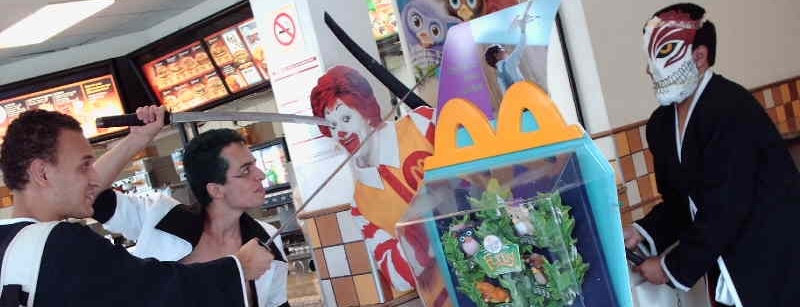
Cosplay, a Japanese portmanteau of the English words “costume” and “play”, saw a massive surge in popularity in the West, starting in the late 1990s. Dressing up in costumes and going to conventions has been a niche interest in the West since the popularization of the science fiction, gothic, fantasy and horror literary genres starting at the turn of the 20th century. With the advent of the motion picture industry, the popularity of these costume conventions grew dramatically. Though, it was not until the mid to late 1990s that dressing up as anime characters became common. This was through the massive influence of legendary anime series like Dragon Ball Z, Sailor Moon, Cowboy Bebop and Pokemon, which were syndicated and adapted from Japan to Western nations.


Around 2006, a new term began to be used mainly in American forums, for a western white person who was obsessed with Japanese pop culture; the term weaboo. According to Dictionary.com and Knowyourmeme.com, it was coined by author Nicholas Gurewitch as a nonsense term in his 2005 webcomic known as The Perry Bible. Snippets of the webcomic were posted onto problematic forum site 4Chan. Up until that time, 4Chan users and internet trolls in general were using the colloquial pejorative wapanese (mixing wannabe or white and Japanese) to insult white people overly fond of Japanese culture to an annoying, pitiful and culture-vulture-like degree. This caused heated exchanges between anime and manga fans and trolls. The abuse became so rampant that 4Chan web moderators began using a keyword filter to replace the pejorative wapanese anytime anyone typed it with the nonsense term weaboo. Weaboo became a new popular alternative to wapanese and it quickly spread all over the internet as a meme. The term and its popularity was similar to the term wankster (originally coined as wanksta; a pejorative from African American English dialects meaning wannabe or white gangster) which was popularized in 2002 by American rapper 50 Cent in his song of the same name. Internally, Japanophiles referred to themselves as otaku, which is a Japanese term for a pop culture enthusiast or consumer. As a term, weaboo began to gain ground as Japanese soft power did in the Western mainstream. It gained so much popularity that it began to be used to also describe Western Japanophiles who were not white. By the mid 2010s, the term weeb, a descendant of weaboo via word clipping, became overwhelmingly popular and was also used self referentially in an ironic way by many western otaku.

That is all to say, that the American government, and specifically World War II American commanders Douglas MacArthur and Matthew Ridgeway, are to blame for weaboos in the West. Specifically their actions in the reconfiguring of the major conglomerates, known as the zaibatsu. These zaibatsu, pre-1945, were leveraged by the Emperor when making his decisions and implementing the army draft or collecting taxes. The US would allow major industrialization in Japan as an ace in the hole in America’s fight against the communists, i.e. the Soviets and the Maoist Chinese. The second sin was the introduction of free market capitalism and consumerism. The third culprit is Chapter II Article 9 of the MacArthur Constitution which completely and absolutely prohibits Japan from possessing an Army, Navy, Air force or any other national armed force. Also Japanese culture is inherently cool and amazing, so it’s no wonder that weaboos exist, as cultural confusion of some sort or another exists in all multicultural western nations.
Works Cited
- “Hong-wu: Year 4, Month 12, Day 3 – Hong-wu: Year 5, Month 1, Day 4” Ming Shilu, Translated by Geoff Wade, (Singapore: Asia Research Institute and the Singapore E-Press, National University of Singapore, 2005. Originally Compiled in 1491 by Liu Chi), http://epress.nus.edu.sg/msl/reign/hong-wu/year-4-month-12-day-7 ↩︎
- Ivy Maria Lim. From Haijin to Kaihai: The Jiajing Court’s Search for a Modus
Operandi along the South-eastern Coast (1522-1567), (Journal of the British Association for Chinese Studies, Vol. 2, July, 2013), p. 2 ↩︎ - John Fairbank, Edwin Reischauer & Albert Craig. East Asia : Tradition & Transformation, (Boston: Houghton Mifflin Co., 1989), p. 178-179 ↩︎
- Aimé Humbert. Japan and the Japanese, Translated by Frances Cashel Hoey. (Cambridge, England, UK: Cambridge University Press, 2016. Originally Published in 1874), p. 51 ↩︎
- Noel Perrin. “Chapter One,” Giving Up the Gun: Japan’s Reversion to the Sword, 1543-1879, (Boston: D.R. Godine, 1979), p. 5-6 ↩︎
- Arima, Seiho. The Origin of Firearms and Their Early Transmission, (Tokyo:
Yoshikawa Kobunka, 1962), p. 615-633 ↩︎ - Fernão Mendes Pinto. “How Firearms Came to Japan,” The Travels of Mendes Pinto, Edited and Translated by Erica D. Catz, (Chicago & London: The University of Chicago Press, 2014. Originally Published as Peregrinação in Lisbon in 1614), p. 321 & 480 ↩︎
- C.R. Boxer. “The Palm of Christian Fortitude”, The Christian Century in Japan: 1549-1650, (Los Angeles: University of California Press, 1967), p. 321-440 ↩︎
- Valentim Carvalho. Apologia of Japan, Edited by José Eduardo Franco, (Lisbon & Macau: Macau Scientific and Cultural Centre, 2007, originally written in 1617) ↩︎
- R. H. Hesselink. “A Man for the Jesuits: Omura Sumitada,” in The dream of Christian Nagasaki : world trade and the clash of cultures, 1560-1640, (Jefferson, North Carolina: McFarland & Company, Inc., 2015), p. 44-45 ↩︎
- Mihoko Oka. “Introduction”, The Namban Trade: Merchants and Missionaries in 16th and 17th Century Japan, (Leiden ; Boston: Brill, 2021), p. 10 ↩︎
- Joseph Cummins. “The Shimabara Uprising,” History’s Great Untold Stories
Larger Than Life Characters & Dramatic Events that Changed the World, (Washington D.C.: National Geographic, 2006), p. 89 ↩︎ - C.R. Boxer. “The Sakoku Edict”, The Christian Century in Japan: 1549-1650, Translated by C.R. Boxer, (Los Angeles: University of California Press, 1967. Originally Published in 1636), p. 439-440 ↩︎
- Mark E. Cunningham & Lawrence J. Zwier, “The Christian Threat,” in The End of the Shoguns and the Birth of Modern Japan, (Minneapolis: Twenty First Century Books, 2013. Originally Published 2009), p. 17-22 ↩︎
- Hiraishi Naoaki. “E. Kaempfer’s Treatise on Japan’s Policy of Seclusion
and Its Influence on Japan’s Decision to Open the Country,” (Tokyo: Humboldt University of Berlin, 2008) p. 170-175 ↩︎ - Christopher Joby. The Dutch Language in Japan (1600-1900)
A Cultural and Sociolinguistic Study of Dutch as a Contact Language in Tokugawa and Meiji Japan, (Leiden ; Boston: Brill, 2021) p. 289-293 ↩︎ - Donald Keene. “The Call of the West,” The Japanese Discovery of Europe, 1720-1830, (Stanford, California: Stanford University Press, 1969), p. 76-78 ↩︎
- Michael S. Laver. “Prohibitions on Japanese Travel Abroad,” The Sakoku Edicts and the Politics of Tokugawa Hegemony, (Amherst, NY: Cambria Press, 2011) p. 36-39 ↩︎
- John W. Dower. “Chapter Two: Perry,” Black Ships & Samurai: Commodore Perry And The Opening of Japan (1853-1854), (Boston: Massachusetts Institute of Technology, 2008) p. 6 ↩︎
- “Treaty of Amity and Commerce between the United States of America and the Empire of Japan (Treaty of Amity and Commerce, Harris Treaty),” (“The World and Japan” Database at The University of Tokyo, Tanaka Akihiko, Published online, Originally Published 1858) ↩︎
- Daivd G. Wittner. “The Opening of Japan,” Commodore Matthew Perry and the Perry Expedition to Japan, (New York: The Rosen Publishing Group, 2005) p. 91 ↩︎
- Samuel Wells Williams. “Wednesday, Jul. 13,” A Journal of the Perry Expedition to Japan (1853-1854), (Shanghai: Kelly & Walsh, 1910), p. 58 ↩︎
- Kazuo Takahashi. The Impacts of Japanese Television Programs : World wide “Oshin Phenomena” (Tokyo: Tokyo Univerisity Repository for Academic Research, 1998) ↩︎

Leave a Reply